The next few days we spent making our way back to Kathmandu, ever reminded of how far Lingtep and Boulder really are!! How in the world did we end up together?! We talked about the Rockies and Himalayas perhaps being the magnetic forces at play!!
We return safe and totally worn out to the warm arms of family in Kathmandu. We were both moved by the past week and a half. Changed for the better because of the journey. A journey that continues.
We will keep you posted on the upcoming community meetings to see where we'll be guided by the people who are trying to plan their own way forward.
Monday, February 28, 2011

Friday, February 25, 2011
Lingtep field visit - Day 8
As we woke in the early morning darkness to begin our trek down to Handrung where we'd meet our vehicle, we said our goodbyes to family and friends. We hiked down the stone path with thoughts of "next time." We will be returning to Lingtep and Taplejung to keep the project moving. It's a time consuming trip -- just to get to Lingtep requires three full days of travel -- but surely near in the future (we will see the fruits of our combined effort and labor.
We moved downhill along the Mewa River feeling sad to be leaving; excited to return to family in Illam, Jhapa, and Kathmandu; and trying to better understand our purpose within the project.
As often is the case hiking through the mountains, some of the most meaningful moments and discussions evolve. This was a time when uncertainty rang in our conversations. When will we realistically be able to return for a longer period of time? Will we be able to accomplish what we've set out to do? How do we engage with our own community in Lingtep? How do we engage with a village we are less familiar with? Should we simply donate the money to a fine organization that already knows how to do this sort of thing?
Ultimately, through the fog of uncertainty comes clarity of purpose. We will need to be adaptable and unwaveringly committed. Thus far, we've been able to maintain this. And we see that this project is in a unique position of being able to inspire and generate small pieces of positive change from an 'insider' position (with outsider support).
We moved downhill along the Mewa River feeling sad to be leaving; excited to return to family in Illam, Jhapa, and Kathmandu; and trying to better understand our purpose within the project.
As often is the case hiking through the mountains, some of the most meaningful moments and discussions evolve. This was a time when uncertainty rang in our conversations. When will we realistically be able to return for a longer period of time? Will we be able to accomplish what we've set out to do? How do we engage with our own community in Lingtep? How do we engage with a village we are less familiar with? Should we simply donate the money to a fine organization that already knows how to do this sort of thing?
Ultimately, through the fog of uncertainty comes clarity of purpose. We will need to be adaptable and unwaveringly committed. Thus far, we've been able to maintain this. And we see that this project is in a unique position of being able to inspire and generate small pieces of positive change from an 'insider' position (with outsider support).
Thursday, February 24, 2011
Lingtep field visit - Day 7
We continued our discussions within the village, which inevitably combined with family visits - a pure delight after so many years. Internal village politics is a reality of any local project. We were spending a great deal of time explaining to a few stubborn individuals the ethos of this project. Some people, we are finding, show resistance, because they think there surely must be an ulterior motive - perhaps building the family name for future purposes or attempting to out-do others. These doubting individuals are in the minority, but also hold a strong position in the community. We certainly want everyone to understand in full transparency our incentives for this project.
Building off of both of families' history of community service and belief that everyone deserves an equal opportunity in life, we simply seek to give back where there is a need. Dhirendra shared about how the conditions for education largely remains the same, beyond the fact that there are now pens, paper, and booklets at the school (which he didn't have - drawing in the dirt floor to learn their lessons). We want to provide support to a community-driven project. To the extent possible, we want to support improved education through infrastructure, but even more through community groups that ensure quality and accountability at the school - like a parent teacher association. For example, teacher attendance is one of the central problems throughout Nepal's education system. We observed that Lingtep is no exception. PTA type groups have proven to improve standards and attendance, while offering forums for parents to engage more fully in supporting their childrens' education.
Our goals is long-term. This trip has only reinforced this understanding. We walked away thinking that perhaps supporting Lingtep in some regard (potentially to improve the 3rd and 4th grade classroom) may be an easier immediate project. Longer-term might be a school in another village in Taplejung. Beyond the school in Ochhechhre, there are villages further north towards the Tibetan border that are even more remote that may be needing some form of assistance.
Building off of both of families' history of community service and belief that everyone deserves an equal opportunity in life, we simply seek to give back where there is a need. Dhirendra shared about how the conditions for education largely remains the same, beyond the fact that there are now pens, paper, and booklets at the school (which he didn't have - drawing in the dirt floor to learn their lessons). We want to provide support to a community-driven project. To the extent possible, we want to support improved education through infrastructure, but even more through community groups that ensure quality and accountability at the school - like a parent teacher association. For example, teacher attendance is one of the central problems throughout Nepal's education system. We observed that Lingtep is no exception. PTA type groups have proven to improve standards and attendance, while offering forums for parents to engage more fully in supporting their childrens' education.
Our goals is long-term. This trip has only reinforced this understanding. We walked away thinking that perhaps supporting Lingtep in some regard (potentially to improve the 3rd and 4th grade classroom) may be an easier immediate project. Longer-term might be a school in another village in Taplejung. Beyond the school in Ochhechhre, there are villages further north towards the Tibetan border that are even more remote that may be needing some form of assistance.
Wednesday, February 23, 2011
Lingtep field visit - Day 6
With the memorial bench built and the related rituals complete, we spent the next two days dedicated to understanding the education needs within the community.
When we'd first walked into the village, past the school, we were initially struck by the surprisingly good quality building currently there. While we'd not necessarily intended to build the school in Lingtep, we'd heard that there may be need for some form of help. Our gut reaction was that this village is not the most in need - the main school building is in good shape, having been built within the past few years with a full staff of teachers.
Just before departing Kathmandu, we were hearing that the village is interested in expanding the school to include two higher grades. Speaking with community members, including students themselves, we found that those two higher grades are available in a village only one hour walk away. While that might sound far, for kids in their late teens, it is quite do-able - they don't even need to relocate or stay in a hostel. We heard this from families and students.
Our sight shifted and we discussed the possibility of another poorer community uphill from Lingtep that has no primary school - the closest is approximately 30 minutes downhill and uphill walk away (a long way for the youngest kids!). The village name is Ochhechhre. Due to time constraints (Dhirendra and I were under tight timelines to return to our respective work places), we were unable to visit the village ourselves. We did, however, discuss extensively with Dhirendra's oldest brother who is our main point of contact in the village. He will take the lead to travel to the village and gather the information to assess whether their is the adequate need and will.
Despite our feelings that the school in Lingtep may not be the most in need, we were hearing a great deal from the community that the school does need help. Folks were expressing a strong desire for us to first look at the ancestral village before turning to others. We decided to investigate more fully for ourselves.
We spent a couple hours at the school and realized something we'd not appreciated when we were walking by during non-school hours - the broken down building next to the new school was actually the 3rd and 4th grade classroom. The floor was bare, full of dust and classes shared the single space. At first, we'd simply thought that was an extra space - remainders of the old school. This was certainly better than nothing, but perhaps an area where the Taplejung School Project could assist.

We spoke with each and every 3rd and 4th grader there that day. It's hard not to be won over by such sweet kiddos.


All along, we've been less concerned with the infrastructure. Building a school involves rocks, mortar, logs, tin for the roof. But without the community's involvement, it will only be a building. We discussed with the community members about the importance of local ownership. Should they request TSP's help for improving the school's infrastructure, the condition we told them would be local people's involvement. That could be donating whatever they can (sending a family member for help, logs, rocks or whatever capacity they can). And it is the community involvement that has thus far and will certainly continue to be our central focus.
When we'd first walked into the village, past the school, we were initially struck by the surprisingly good quality building currently there. While we'd not necessarily intended to build the school in Lingtep, we'd heard that there may be need for some form
 of help. Our gut reaction was that this village is not the most in need - the main school building is in good shape, having been built within the past few years with a full staff of teachers.
Just before departing Kathmandu, we were hearing that the village is interested in expanding the school to include two higher grades. Speaking with community members, including students themselves, we found that those two higher grades are available in a village only one hour walk away. While that might sound far, for kids in their late teens, it is quite do-able - they don't even need to relocate or stay in a hostel. We heard this from families and students.
Our sight shifted and we discussed the possibility of another poorer community uphill from Lingtep that has no primary school - the closest is approximately 30 minutes downhill and uphill walk away (a long way for the youngest kids!). The village name is Ochhechhre. Due to time constraints (Dhirendra and I were under tight timelines to return to our respective work places), we were unable to visit the village ourselves. We did, however, discuss extensively with Dhirendra's oldest brother who is our main point of contact in the village. He will take the lead to travel to the village and gather the information to assess whether their is the adequate need and will.
Despite our feelings that the school in Lingtep may not be the most in need, we were hearing a great deal from the community that the school does need help. Folks were expressing a strong desire for us to first look at the ancestral village before turning to others. We decided to investigate more fully for ourselves.
We spent a couple hours at the school and realized something we'd not appreciated when we were walking by during non-school hours - the broken down building next to the new school was actually the 3rd and 4th grade classroom. The floor was bare, full of dust and classes shared the single space. At first, we'd simply thought that was an extra space - remainders of the old school. This was certainly better than nothing, but perhaps an area where the Taplejung School Project could assist.

We spoke with each and every 3rd and 4th grader there that day. It's hard not to be won over by such sweet kiddos.


All along, we've been less concerned with the infrastructure. Building a school involves rocks, mortar, logs, tin for the roof. But without the community's involvement, it will only be a building. We discussed with the community members about the importance of local ownership. Should they request TSP's help for improving the school's infrastructure, the condition we told them would be local people's involvement. That could be donating whatever they can (sending a family member for help, logs, rocks or whatever capacity they can). And it is the community involvement that has thus far and will certainly continue to be our central focus.
Tuesday, February 22, 2011
Lingtep field visit - Day 5

Eager to get started on our long-day hike up to Lingtep, we were up early and on the road to start Day 4. We made it back to Handrung (where Dhirendra's illness struck...and a place believed within the family to have ancestral 'bad karma' as it were). We grabbed our pack and were on the way.
Though Dhirendra was still quite weak, were made good time. All along the path, Dhirendra shared stories about what had changed, memories of journeys past, and important spots along the way. Meg was taking it all in, as if visiting a mythical land she'd only dreamed of.


It was growing increasingly clear throughout the day that this trip was about so much more than pragmatic reconnaissance work for a school.
In the early afternoon, we reached Lingtep Village. Despite Dhirendra's exhaustion, we immediately jumped into helping the dozens of community members engaged in building the stone memorial bench for our father, the late Tulsi Prasad Nalbo.
Despite overwhelming experience of meeting with many new relatives and the villagers, Meg warmly accepted the culture and immediately became part of it.

After building the bench (located just down the path from the village school, where Dhirendra's grandparents' stone memorial bench has been built), the religious/ancestral ceremonies began. First, the ceremonies at the memorial.


Then came the evening ceremonies which went late into the night. These ceremonies were filled with the essentials of Limbu culture - honoring the ancestors, recounting histories from generations and generations ago, drinking copious amounts of Limbu alcohol (tongba), recounting stories in memory of the honored person at the ancestral home, eating lots of yummy food (including the sacrificed goat), mixing and mingling of all age-groups, and an overall loving, warm environment of family and life-long friends.
That night, we fell asleep to the sounds of traditional Limbu ceremonial singing, bundled in our warm clothes.
Monday, February 21, 2011
Lingtep field visit - Day 4
Day 4 was a day of rest. Dipendra and our cousin departed for Lingtep in the early morning, leaving Dhirendra and I behind to rebuild some strength after Dhirendra's bout with food poisoning.
We rested and took short walks around the Taplejung Bazaar. It had been 7 years since either of us had been there, so it was fun to see it again. Last we'd been there was during the height of the Maoist insurgency during the on-going warfare between the Maoists and the National Police/Army (one of the important eastern stations is in the district headquarters). Also highlighting our last trip was the huge fire that burned down half the bazaar (ignited by children studying by a candle that fell over). When we went to look at the devastating effect of the fire, we nearly got injured by the sudden explosion of a cooking gas cylinder that was buried underneath the remains of burnt houses. The newer part of town has broader roads and some solid looking concrete buildings.
Dipendra rushed on to Lingtep in order to attend to some family 'business.' Dhirendra's beloved father (Tulsi Prasad Nalbo) was a respected leader within the region. Since his passing in 2005, the family has planned to build a memorial bench within the village in his honor. This winter was nominated the best time to do it. Dhirendra's oldest brother who lives in the village (Madan) had done much of the planning, but activities were scheduled to start immediately...another motivating factor to get us to the village in time to help with the construction of the 20 foot long stone memorial bench.
Thanks to Meg, Dipendra and other relatives' love and care, Dhirendra regained his strength this day; we were relieved to know that we'd be able to continue on with our journey to Lingtep (only a couple of days delayed).
We rested and took short walks around the Taplejung Bazaar. It had been 7 years since either of us had been there, so it was fun to see it again. Last we'd been there was during the height of the Maoist insurgency during the on-going warfare between the Maoists and the National Police/Army (one of the important eastern stations is in the district headquarters). Also highlighting our last trip was the huge fire that burned down half the bazaar (ignited by children studying by a candle that fell over). When we went to look at the devastating effect of the fire, we nearly got injured by the sudden explosion of a cooking gas cylinder that was buried underneath the remains of burnt houses. The newer part of town has broader roads and some solid looking concrete buildings.
Dipendra rushed on to Lingtep in order to attend to some family 'business.' Dhirendra's beloved father (Tulsi Prasad Nalbo) was a respected leader within the region. Since his passing in 2005, the family has planned to build a memorial bench within the village in his honor. This winter was nominated the best time to do it. Dhirendra's oldest brother who lives in the village (Madan) had done much of the planning, but activities were scheduled to start immediately...another motivating factor to get us to the village in time to help with the construction of the 20 foot long stone memorial bench.
Thanks to Meg, Dipendra and other relatives' love and care, Dhirendra regained his strength this day; we were relieved to know that we'd be able to continue on with our journey to Lingtep (only a couple of days delayed).
Sunday, February 20, 2011
Lingtep field visit - Day 2 & 3
After a good night's sleep and a filling breakfast, we were on our way to Taplejung District. We were anticipating this to be our final day driving before heading out on a one day hike to Lingtep. Along the way, we saw some of the most beautiful views of the Himalayas and Kanchenjanga (the 3rd highest mountain in the world at 28,169 feet and the guardian of the Limbu community/religion).

We had some tea in Phidim and lunch along the way. Dhirendra was daring with a habanero achar/picke with his daalbhaat (more on that later). As we went further into the mountains (or hills as they're called in Nepal - the mountains have snow year round), we were seeing more and more flags and political rhetoric for the Limbuwan ethnic movement, demanding an autonomous state in the eastern part of Nepal.
As we drew closer to our destination (Handrung), we started seeing familiar landscape. Though Meg has been to Taplejung twice in the past, this time was particularly special as Dhirendra showed her important family landmarks - ancestral villages of aunts, brothers-in-laws, friends, and even the village where Dhirendra studied. It is a one-day walk away from Lingtep village (Dhirendra's home) and is where he studied classes 7-10 and met one of his closest friends. He recalled with his brother stories, as we drove along, about carrying the sacks of dried rice and lentils to the village in sacks tied to their backs. They'd depart on Sunday for the one-day trek, sleep for the week in a make-shift hostel where they'd study by kerosene-lamp and make their food they brought with them. On Friday afternoon, they walk back home after class to their village to spend a day and a half with family. All at the age of 12. They recounted funny stories about fairs in one of the towns at the confluence of two rivers along the way, and short-cuts along the path. In many ways, this was the root of Dhirendra (and Dipendra, his brother)'s motivation to provide schooling to Taplejung District children closer to their homes.
We arrived at the banks of the Tamur River to plop ourselves down for the night, when Dhirendra's tummy started aching more than just a spicy burn (return of the darn habanero achar). Before we new it, he was struck head-on with food poisoning.
Needless to say, Day Two ran into Day Three as we drove the 2.5 hour off-road 4WD drive (made into 1.5 by our skillful driver and friend Uttam) to the top of the "hill" and the Taplejung District Hospital emergency room. They got a intravenous saline drip into Dhirendra immediately. Almost 20 hours (and 5 saline bottles later), Dhirendra was discharged from the hospital. The rest of us were simply grateful that he was on the mend. The evening of day three, we all relocated to one of our relatives/uncle's homes in the bazaar area. After a frightening many sleepless hours/days, things were looking up.

We had some tea in Phidim and lunch along the way. Dhirendra was daring with a habanero achar/picke with his daalbhaat (more on that later). As we went further into the mountains (or hills as they're called in Nepal - the mountains have snow year round), we were seeing more and more flags and political rhetoric for the Limbuwan ethnic movement, demanding an autonomous state in the eastern part of Nepal.
As we drew closer to our destination (Handrung), we started seeing familiar landscape. Though Meg has been to Taplejung twice in the past, this time was particularly special as Dhirendra showed her important family landmarks - ancestral villages of aunts, brothers-in-laws, friends, and even the village where Dhirendra studied. It is a one-day walk away from Lingtep village (Dhirendra's home) and is where he studied classes 7-10 and met one of his closest friends. He recalled with his brother stories, as we drove along, about carrying the sacks of dried rice and lentils to the village in sacks tied to their backs. They'd depart on Sunday for the one-day trek, sleep for the week in a make-shift hostel where they'd study by kerosene-lamp and make their food they brought with them. On Friday afternoon, they walk back home after class to their village to spend a day and a half with family. All at the age of 12. They recounted funny stories about fairs in one of the towns at the confluence of two rivers along the way, and short-cuts along the path. In many ways, this was the root of Dhirendra (and Dipendra, his brother)'s motivation to provide schooling to Taplejung District children closer to their homes.
We arrived at the banks of the Tamur River to plop ourselves down for the night, when Dhirendra's tummy started aching more than just a spicy burn (return of the darn habanero achar). Before we new it, he was struck head-on with food poisoning.
Needless to say, Day Two ran into Day Three as we drove the 2.5 hour off-road 4WD drive (made into 1.5 by our skillful driver and friend Uttam) to the top of the "hill" and the Taplejung District Hospital emergency room. They got a intravenous saline drip into Dhirendra immediately. Almost 20 hours (and 5 saline bottles later), Dhirendra was discharged from the hospital. The rest of us were simply grateful that he was on the mend. The evening of day three, we all relocated to one of our relatives/uncle's homes in the bazaar area. After a frightening many sleepless hours/days, things were looking up.
Friday, February 18, 2011
Lingtep field visit - Day 1
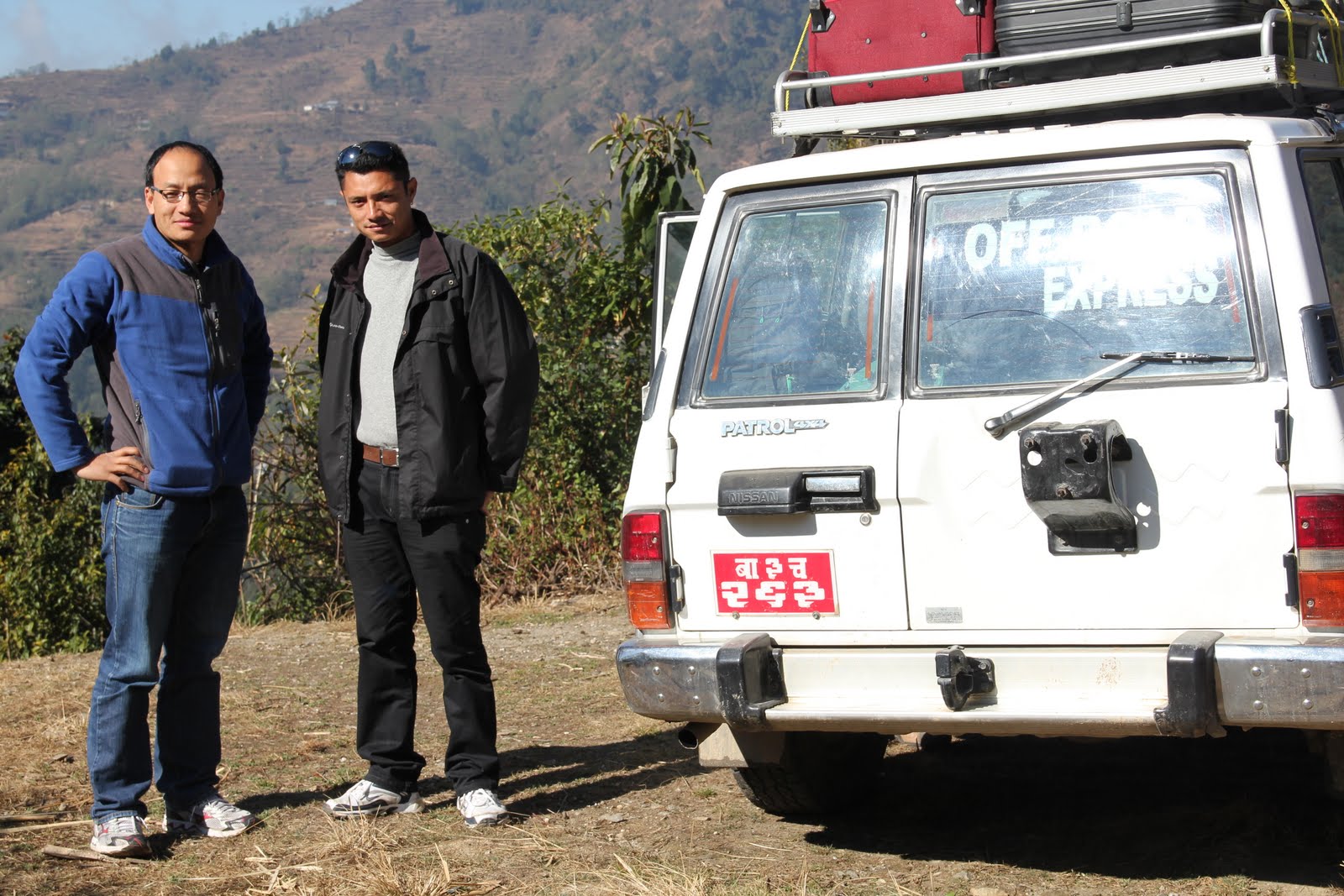
Day one of our trip to Lingtep village in Taplejung (Dhirendra's birth place and where he spent his childhood until the age of 19) began in the early morning darkness of Kathmandu. In the interest of time and money, we decided to hire a 4WD vehicle and driver who Dhirendra knows through his frequent work field visits. Uttam (our friend and driver) picked the team up just before 6am. Beyond Uttam, an essential team member, it was the two of us and Dipendra Nalbo (Dhirendra's immediate older brother, best man at our wedding, and intimately involved with the Taplejung School Project). We had an extra seat in our vehicle, so we offered the spot to a cousin who was returning to the village after two years working in the Middle East. It's better luck to travel not in a group of three, so we were happy to have an extra family member along for the three day trip to Lingtep.
Our drive out of the Kathmandu Valley was particularly memorable with the sun rising over the Himalayas north of the capital. The skies were crystal clear (as they often are this time of year) and we all agreed that traveling out of Dhulikhel was a great idea.
The day's drive was long - nearly 16 hours!! The new road JICA (the Japanese development agency) is building impressed us all. We later found out that it was US development efforts a few decades ago that actually was the brain child for the highway, but that's a digression. Along the highway, the afternoon was highlighted by a lunch of tasty rice and curry home cooked by a friendly family we happened upon. There was a beautiful mountain stream in the back of the home, where we freshened up.

The day brought us from Kathmandu, through the mid-central hills (most recently Maoist strong-holds), along impressive river beds in deep valleys, dusty desert dry village roads and recently constructed "pitch" highways with Japanese construction vehicles and men in hard hats, to southern Nepal (the eastern Terai), past pockets of Nepal's small Muslim communities and Bhutanese refugee camps, into the area where many lowland (Madeshi) ethnic movements find their strongest roots, and back north into the foothills of eastern Nepal. Phew! Finally, well into the night, we made it to Illam - Nepal's tea capital - for a delightful night's sleep.
Wednesday, February 16, 2011
Eastward Bound
After much waiting, the time has arrived for us to finally make the journey to Taplejung after many years. Despite competing professional pressures, we've carved out two weeks from our schedules to make the long-awaited trip to Lingtep, Taplejung. Prior to our departure, we're trying to meet up with a friend who has extensive experience with school building projects in Nepal and the associated community development that goes hand-in-hand with that. The goal of this trip is to do the preliminary needs assessment on.
Our starting point is an understanding that either we pursue building onto the Lingtep primary school, so that kids in the surrounding villages will have local access to education through grade 10 - or 'high school' (pre-SLC level) - rather than having to take up boarding in a regional school OR we pursue building from the ground up a new primary school in an area where village children are simply unable to attend any close schools. Our hunch is that we'll see there is a strong need for both.
Tuesday, December 28, 2010
Holiday Generosity!
We are overwhelmed with the generosity of friends and family over the past month. Thank you all for your thoughtful contributions to the Taplejung School Project. Every little bit moves us closer to finalizing the land purchase, securing building materials, creating a parent teacher association, and eventually providing more accessible education to young children in rural eastern Nepal who otherwise wouldn't have the opportunity. For this, we thank you. We will keep posting updates as we get them. May you all have a very happy and healthy New Year!!
Friday, December 24, 2010
Turtle and the Hare
The question is raised, why are there always delays? I suppose it is because we have full (plus) jobs we tend. We're still chugging away and building our financial base. As always looking for more contributions and getting some great fundraising ideas from friends. If there is a marathon in Bangladesh over the next year, Meg will be first to sign up and all will be expected to chip in for the school...and sports drinks! This is one hot country. But we digress.
The planned scouting trip, which was intended for October of this year, will now likely take place in April, 2011. Between major activities at work, changes in personnel in both of our offices, and struggling to find time to simply meet up ourselves, we've needed to wait until the Spring for our scouting trip. This gives us time to build rapport in order to take the full two weeks off of work required to get out to Taplejung.
The great news is that a new advocate for our school has joined us - a baby niece was born October 1st (daughter of Dhirendra's brother, Dipendra)!! We are happy to report that she looks really smart and promises to be a great addition to the Taplejung School Project team.
Saturday, June 19, 2010
Back in the sub-continent
Ten quick months later and we’re back on track. Over the past many months, much has changed. We moved from Washington DC to Dhaka, Bangladesh. Just yesterday, Dhirendra moved again to Nepal to start a new journey with the International Crisis Group (one of the leading conflict analysis international organizations in the world!). Although the heartache of living temporarily apart burns, we are rewarded by new opportunities. With daily flight to/from Dhaka/Kathmandu, we will be able to make serious headway with the Taplejung School Project. This October, we are planning our first scouting trip to Taplejung since birthing this dream just over two years ago at our Colorado wedding. Before heading to Taplejung, we will spend the next few months preparing, planning, and networking. Stay tuned!!
Sunday, August 02, 2009
Slow but steady progress
We are seeing that not being based in Nepal and working on the school is a challenge. Dhirendra’s now back from his recent two-week trip to Nepal.
After a week and a half project in Dharamsala, India with the Tibetan Government in Exile, Dhirendra spent two weeks in Kathmandu. The trip was productive in many ways. Of course, he was able to spend time with family and friends – an opportunity that is few and far between. He also made notable progress in an upcoming project with his organization – the Institute for Multi-Track Diplomacy (IMTD) – on post-conflict reconciliation. Among other notable figures with whom he spoke was the Prime Minister, Mr. Nepal. The conclusion on all sides was overall consensus that the project is necessary. With adequate funding, the plan is to move forward this Fall.
Last, but not least, Dhirendra made key contacts for the Taplejung School Project. He met first with Mr. Dambar Dhwoj Thumbahanphe, one of the political representatives for the Taplejung constituency. He will be important in the latter stages of gaining political support in the district and for guidance on regulations and ordinances within the Ministry of Education. Dhirendra also spoke with villagers (visiting Kathmandu) and discussed possible properties centrally located within Lingtep village whose owners might be willing to partially donate the land. Finally, a young woman by the name of Kopila Langwa agreed to coordinate a needs assessment this November. Kopila is a Limbu from Taplejung who is currently studying in Kathmandu for her graduate degree in Education. She will act as our eyes and ears, gathering information and evidence from both Lingtep and Changa (Nalbu) villages on the challenges of the youth (both girls and boys) in attending school. She will also report back on the local politics of the villages on this issue.
Our immediate challenge is gathering further information and developing a strategy on building the school, costs of materials, and curriculum development.
Monday, June 22, 2009
Dhirendra's work in Nepal
Dhirendra's been in Nepal since June 14th. In addition to visiting family and doing work (for the Institute for Multi-Track Diplomacy www.imtd.org), he's been talking with villagers from Taplejung that have been in Kathmandu. We'll put up a post with more details after he returns to the States in July.
Thursday, May 21, 2009
Brief update on Nepal's political scene
Since many people have asked us about the political situation in Nepal the past few weeks, we thought we’d post an update.
Already facing stumbling blocks, Nepal’s fragile peace process suffered another blow as the Prime Minister Puspa Kamal Dahal Prachanda resigned from his post on May 4, 2009. A weeks-long political deadlock on the issue of the Cabinet’s decision to fire the Chief of Army resulted in the crumbling of the Maoist-led coalition government. Since the Prime Minister’s resignation, major opposition parties, particularly the Nepali Congress (NC) and leftist party Nepal Communist Party United Marxist Leninist Party (UML), are arduously trying to firm a new government.
Both parties, NC and UML have proposed as their candidate for the Prime Minister, UML’s former General Secretary Mr. Madav Kumar Nepal. The irony of his candidacy is that he lost both his candidacies during the Constituent Assembly election a few years ago. Due to his embarrassing defeat, he resigned from his post as party General Secretary.
It is not clear whether Mr. Nepal would gain the needed support from other political parties. Nonetheless, given Nepal’s ongoing frail peace process, it is not a critical issue of who leads the new interim-government instead whether the new government can become sustainable and effective to carry out the peace process into its logical endpoint. At the forefront of this process is the integration of Maoist ex-combatants into Nepal’s security forces, to finish writing a new ‘Peoples’ constitution by May 2010, and to return the confiscated individual property that was seized by the Maoist during the war.
Political analysts argue that without the Maoist’s support no government can sustain and precede Nepal’s peace process effectively. The twelve-year long civil conflict and the Constituent Assembly election have established the Maoist as an indispensable political force. This political situation requires that if the peace process is to be successful, the Maoist and all political parties need to work together.
Wednesday, May 06, 2009
A Year of Change and Progress for the TSP
The year May 2008 – May 2009 went by quickly, marked by many memorable moments – personally, nationally, and globally. After Dhirendra completed his second Master’s degree with high honors in Conflict Resolution, we bid farewell to West Yorkshire – a part of England that had grown to be a part of us. We moved back to the U.S. laying our bags and lives down in Washington, DC.
No sooner had we got here, when a new president decided it was also a nice place to live. The festivities and excitement of Washington, DC surrounding the 2008 elections, 2009 inauguration, and up to present have brought with them a renewed sense of optimism for us, as we continue to face many challenges in our professional lives (no thanks to the economic crisis). After over six months of being in DC, it looks like our path ahead is starting to take shape.
Nepal, too, has had its fair share of ‘change’ over the past 12 months. As many of you will remember from our wedding reception, we toasted Nepal officially becoming a federal republic on May 26th, ending a centuries-old monarchy and promising a new ‘inclusive democracy’. Up until yesterday, a Maoist-led coalition interim government was functioning with the promise of writing a new constitution that would (hopefully) be completed by May 2010. But that was yesterday. As of today, the political crisis has again flared, leaving many unknowns in Nepal's future. Beyond Kathmandu, the political situation has seen little change. In particular, the indigenous and dalit communities (lowest caste) continue to struggle – even taking up arms – for their basic rights. This is nowhere more true than in Taplejung where there have been countless district-wide strikes.
Throughout these eventful times, we have continued to push forward with the Taplejung School Project (TSP). The pace has proceeded more slowly than we’d first envisioned, but the diligence and measured strides we hope will prove to be the foundations of a stronger, more sustainable school.
We have been in contact and consultation with local villagers from Taplejung, who continue to reiterate their need for this school. From these conversations, we’ve identified two potential villages with geographic structures making present primary schooling nearly-inaccessible to half of their populations.
This early June, Dhirendra will be visiting Dharamsala, India as part of his involvement with a conflict resolution training with the Tibetan Government in-Exile. The remainder of the month, Dhirendra will be in Nepal to meet with non-profit organizations and government representatives (including the newly elected constituent assembly member representing Taplejung), as well as villagers, to begin formal discussions on location (i.e. buying land), legal and policy issues (i.e. district education administration), as well as practical/viable timeframes.
We will continue to post updates on a regular basis, so stay tuned and thank you for your support.
Tuesday, June 03, 2008
Eradicate illiteracy in Tapljung, Nepal
We have our blog up and running after raising enough money at our wedding to buy the School grounds!! There's no greater gift than allowing us to follow our dream to create a primary school in the far northeastern district of Nepal. Although there are some schools in the district, due to the dramatic mountanous terrain, some villages still remain out of the reach of even the basic education system. We'll keep putting up posts as we progress step-by-step through this project. For now, we've hit the ground running with the unbelievable support of family and friends.
Until next time
- Dhirendra & Meg (100% married)
Until next time
- Dhirendra & Meg (100% married)
Subscribe to:
Posts (Atom)